As we saw in the last Encourager: courageous leaders facilitate conflicts; they do not resolve them. At first glance, this may seem paradoxical: leaders are doers, so shouldn’t they also solve problems? The result, however, is that we take people out of responsibility for their own actions. No development is possible this way. When leaders consciously facilitate conflicts, however, the people who created the conflict themselves contribute to finding a solution. In our experience, solutions developed in this way have much more power. How does it work? The process is based on the “Seven Transformations of Leadership” and “Courageous Leadership,” the first two parts of this article. It consists of three steps.
Step 1: Articulate the tension
When a conflict arises, we do not try to resolve it. Instead, we present both sides of the tension as equally valid. For illustration, we will use an interpersonal conflict as an example, but the method can be applied to all types of conflicts.
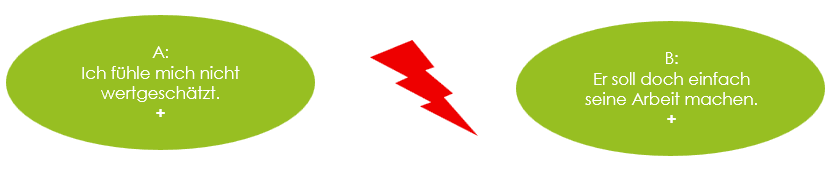
Example: Person A feels that Person B does not value them. Person B believes that people are paid for their work and do not always need to be praised. Instead of working toward a compromise, we create a space for solutions for the opposing parties by presenting the tension from our own perspective. This step is important, and this is where the true leadership lies: it is not the people involved who present their view of things. We do that. No search for causes, no reinforcing explanations from those involved, no dwelling on the past—instead, a space for solutions for the future, which we make visible and shapeable through the tension:
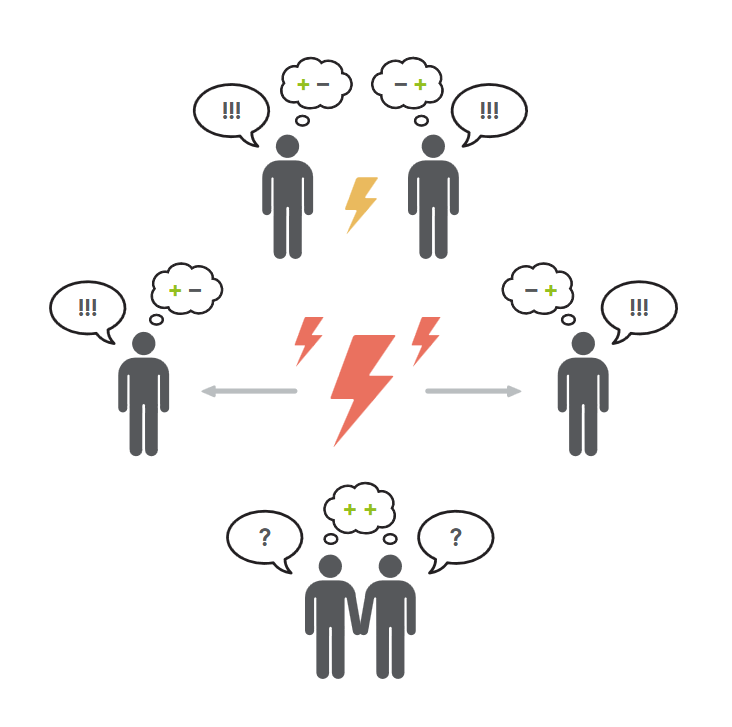
We emphasize that both parties are acting in good faith and with the best of intentions (meaning they are both in “+” mode). We will not go any further at this point.
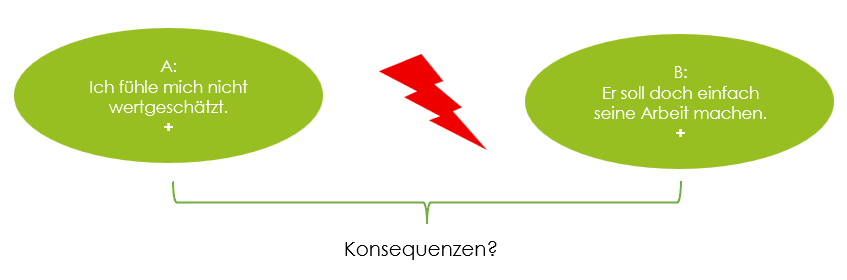
Step 2: Explain the consequences
In a second step, we ask about the consequences: “Imagine nothing changes—what will happen then?”
Possible answers might include:
•“I can’t keep working with him like this.” •“That’s driving me crazy.” etc.
It’s important here that people become aware of the consequences of their actions. We don’t need to be afraid that they’ll do this. Adults are capable of making their own decisions. They’re perfectly capable of handling conflicts and are more resilient than we give them credit for. But we simply don’t give them enough credit, and by imposing our own solutions, we also deprive them of the experience of growing independently. Leadership that lacks courage destroys potential. Or, to stay with the metaphor of the “Seven Transformations of Leadership”: if we are merely “doers,” transformation is not possible.
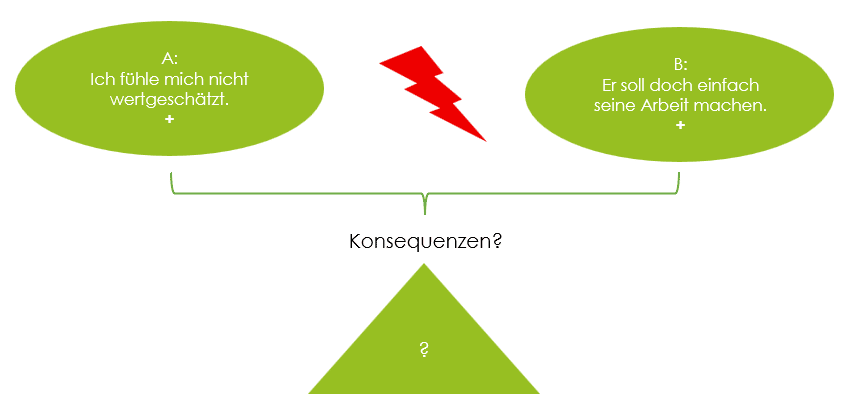
Step 3: Ask open-ended questions
Now comes the third, decisive step: we guide the participants toward finding their own solutions by asking open-ended questions. The first question is always: “What is the one thing you, as a person, can change?”
The answer will be: “Myself.” It’s important that we show backbone here and stand firm on this point: everyone involved has contributed to the situation. So they can also take concrete steps to defuse it. We can then ask further questions along these lines:
•“What specific steps can you take to defuse the situation?” •“What could you do less of to see the situation differently?” etc.
When conflicts are mediated in this way, they can be resolved more effectively than if we, as leaders, give in to the impulse to find compromises ourselves. This clearly illustrates why less leadership often achieves more—and why the “doer” as a leadership model should gradually be phased out.
But what do we do if a + + – relationship doesn’t seem to be forming in the first step? Well, talk to us: there are countless ways to stick with the three steps anyway and still arrive at good solutions.
Best regards, Michael Kres ProMove TM
04/10/2026
This site is registered on wpml.org as a development site. Switch to a production site key to remove this banner.
×
REQUEST A DEMO
Fill out the form beneath and our manager will contact with you
Alexander von Faber
Psychologist with over 30 years of experience in personnel and organizational development – nationally and internationally. Many years of management responsibility at Roche in the areas of Team, People & Leadership Development, HR Business Partnering and Competency Development in Business. Entrepreneur and co-founder of FokusRaum and Trustlead. Main topics: Leadership development. Team development. Culture of trust. Workshop facilitation. Learning and change processes with passion, emotion and impact.
Certified systemic coach bso. Supervisor. Mediator FSM. Inner Coach AIP. Over 30 years of international management experience in the insurance sector. Swiss certified insurance specialist. Focal points: Career coaching. Leadership coaching. Team development. Mediation.
DBVC- and ICF-certified coach (PCC). Social scientist (University of Mannheim). 20 years of experience in corporate HR work in the chemical industry in specialist and management functions. Industries: Chemical, healthcare, public sector, social economy. Focus areas: Executive coaching, leadership development, career transitions, programmes for high potentials, collaboration in complex organisations, transformation processes.
Creative mind, visual designer, and freelance photographer with a passion for powerful imagery and innovative technologies. As an AI power user, he develops modern visual concepts that combine creativity, aesthetics, and digital innovation.
Graduate industrial engineer with over 20 years of international management and project experience in the logistics industry. Systemic coach (ICI-certified) with specialist training in leadership and team coaching. Certified in personality profiling (LINC, DNLA, Hogan) and agile project management (Prince2 Agile). Focus areas: New and outplacement, career coaching/consulting, leadership development and personnel diagnostics.
Diploma in Mechanical Engineering and Management Science (ETH Zurich). Diploma in Advanced Management (SKU). CAS in Business Transformation (HWZ). Long track record as CEO, Global Head of HR, executive manager. Industries: Head of Talent Development at Julius Baer and other banks. Global responsibility for HR at Jet Aviation. Focus: Global HR, transformation and leadership development frameworks. Corporate Leadership Academies. Lecturer at various universities.
Communication and PR Consultant with over ten years of experience including as a manager. Holds a Bachelor’s degree in Communication and Marketing, is a certified PR Specialist and Business Mentor. Experienced in supporting professionals in verbal and non-verbal communication. Since 2024, she has been leading and managing her own coaching and mentoring company.
Federal diploma in HR, Management Coach MCA, Certified Career- & Employability Coach. Longstanding professional and management experience as Business Manager and Head of Human Resources in the areas of IT-services, telecom, tourism and finance. Focus: Organization and management development, HR Consulting, Career & Employability Coaching, Newplacement, Coaching career transformation of people.
Graduate psychologist, focus on psychological diagnostics and psychological counseling, Albert Ludwig University of Freiburg im Breisgau. 30 years of freelance coach, trainer and business developer in industry, sales and service companies. Many years of experience as a consultant and trainer in Germany, France, Austria and Switzerland.
Focus: Career and talent development. Leadership coaching. Workshops in leadership academies.
Systemic management coach. Communication psychologist. Transactional analyst. NLP Master. Enneagram, MSA – Motivation Analysis, Insights. Many years of international experience in the operational and strategic management of human resources in international groups with 5,000 employees or more in the aerospace, electronics, private equity and healthcare sectors. Areas of specialisation: Professional transformation (assessments, recruiting, outplacements). Personnel recognition and development.
Master in Business Psychology. More than 20 years of leadership experience, mainly in HR, organisational development and communication. Industries: Industry, Automotive, Technology, Logistics, Pharmaceuticals, Consulting, Public Sector. Focus: Leadership and team development, organisational and cultural development, change management, talent management, personnel and organisational diagnostics, communication.
Certified adult trainer, certified coach, entrepreneur, and HR specialist. Additional training and certifications: co-development, neuroscience, Insights Discovery®, TRIMA. Experience in the following industries: agri-food, agriculture, security, insurance, and retail. Areas of expertise: management, leadership, communication, self-awareness, skills assessment, and career coaching.
Certified coach in individual and group support, leadership and management coaching, and intercultural coaching. Member of the EMCC. Areas of expertise: leadership, management, talent development, positioning, career and career transition, intercultural topics, and international mobility. Over 15 years of experience in human resources in France and abroad, supporting employees, executives, and their teams in industries such as luxury goods, NGOs, multinational corporations, banking, and the public sector.
Trained industrial psychologist (MSc), with over 20 years’ experience in multinational companies in Switzerland (insurance companies, major distributors, production). He has been working in the areas of assessments (SQS) and management development for 10 years. He is also a trainer in companies and an expert for various federal certifications (SVBK / HRSE). He has supplemented his training with a federal patent as a company mentor/coach. He is also used to conducting team workshops as a facilitator.
Gallup-certified strengths coach. SPIN sales trainer. EMBA graduate (HSG). Over 30 years of banking experience, most recently as a member of the management of ZKB. Entrepreneur. Focus: strengths-oriented transformation. Leadership. Sales. Negotiation skills. Positive psychology. Areas: Finance. Leadership development. Start-ups. AI-supported personnel development. Scientific collaborations.
Diploma Engineer (Technical University). Certified Business Trainer, Coach, Change Management Consultant, and NLP Master. Many years of professional and leadership experience in industry. Transformation of companies and business units. Industries: automotive, mechanical and plant engineering, chemical industry, services, and trade. Core areas of expertise: change processes, restructuring, process optimization, negotiations, coaching, training, and conflict management.
Systemic Business Coach (EMCC Senior Practitioner), Certified PERMA-Lead® Consultant, Certified Practitioner of Positive Psychology (DACH PP), Facilitator, MA in History. Extensive leadership and management experience in academic and scholarly publishing. Areas of focus: Leadership & Executive Coaching, leadership development, team coaching, and organisational consulting with a focus on organisational learning. Industries: energy, logistics, education, science and research, healthcare, public administration, and the cultural and creative industries.
Career & Leadership Coach with an international track record in developing leaders and high-potential professionals. Technology, automotive, consumer goods, retail, and international organizations.
Career development & transitions, leadership development, personal transformation, strategic career planning, navigating complexity, self-leadership, and mental fitness.
MBA, Professional Certified Coach, Certified Professional Coactive Coach, in combination with many years of internal and external economic expertise in business development – and operations, consulting/restructuring, POD/HR and as an entrepreneur. Founded 3 successful companies that have accompanied thousands of people in change processes. Consulted more than 130 large, small, national and international companies from ABB to Walt Disney. Focus: Supporting mid-level managers, senior management, board and C-suite in transformation processes and leadership questions.
Master of Business Administration. Certified value-oriented systemic coach & consultant (CAS/ISO/ICI). Certified value-oriented systemic leadership coach (CAS/ISO/ICI). Certified persolog personality model. Independent coach and consultant focusing on personality development, resilience, and leadership.
Over 10 years of management experience in human resources management, executive and employee development, and experience in founding and building start-ups.
Certified Systemic Coach, NLP Coach, and NLP Master. Certified Insights Discovery® Client Practitioner for personality and team development. Many years of professional and leadership experience in HR – in both the private sector and social organizations. Industry experience includes retail, manufacturing, tourism, services, and social economy. Key focus areas: leadership and talent development, coaching, training, communication, HR management, and team development.
Qualified lawyer (German Diplom-Juristin) with over 16 years of generalist HR experience, including several years in leadership roles. Trained systemic coach. Certified mediator (M.A.) with a specialisation in business mediation. Certified professional in personnel development and change management. Industries: Consulting, retail, and energy sector. Focus areas: Organisational and people development, leadership development, as well as work reintegration and inclusion.
Executive coach, business coach and strategy consultant with many years of management and entrepreneurial experience in the establishment, international scaling and successful further development of companies – including venture capital financing and strategic exits. Profound practical knowledge in strategic leadership, organizational development, growth and leadership in dynamic markets. ICF-ACC and EMCC Practitioner (certification in preparation). Focus areas: Executive coaching, leadership development, business coaching, strategic scaling, innovation, entrepreneurial thinking and organizational development.
Coach, consultant, and communication strategist. Sales, marketing, and management consulting.
Organizational and cultural development, personal development, leadership development, change management, strategic communication, team and group processes, workshop and training design (online, in-person, blended learning).
Certified Executive Coach, member of the EMCC, trained in Human Element, Process Communication, Transactional Analysis, and Co-development. Leadership experience in the renewable energy sector within rapidly growing, complex, and international organizations. Expertise in banking and investment funds. Provides individual and group coaching for executives, high-potential leaders, and managers within teams undergoing significant growth and transformation.
Founder and partner of ProMove TM Dr. oec. (graduate in business economics) HSG. Executive Leadership Coach AoEC. Extensive experience in business management and development. Industries: Aviation, commerce, education, energy, industry, IT, telecommunications, services. Focus areas: Business transformation. Organisational coaching. Executive and leadership coaching. Teaching at universities and higher education institutions. Wide range of publications on the topics of ‘demographic change’, “employability” and ‘courage and management’.
Certified, supervised coach and member of the EMCC. Individual coaching for executives, managers and directors and team coaching. Background: lawyer, head of major projects, manager and over 18 years in HR (4 different positions). Areas of expertise: self-confidence, communication, understanding one’s own modus operandi and the levers of motivation and motivation.
and motivational levers and understanding those of others (DISC and WPMOT certified), managerial posture, imposter syndrome, burn-out. Coaching provided in a variety of sectors: banking, sports, medical, real estate and housing.
M.A. in Psychology, certified Career and Employability Coach. Extensive professional and leadership experience in HR management, leadership development, organizational psychology, and assessments. Coaching focuses: Resilience building and sustainable resource activation for teams and leaders in change processes, based on neuropsychological approaches.
ICF-certified coach (PCC). Mentor coach. M.A. Coaching and Leadership. B.A. Social and Behavioral Sciences. Teaching coach and lecturer in the Master’s program in Coaching and Leadership at EAH Jena. Industries: IT, manufacturing, automotive, pharmaceuticals, logistics, education. Key topics: Executive coaching, career and personal development, communication, change management, agile working methods, digital transformation.
Graduate economist. Certified sales manager. Over 25 years of experience as a trainer, coach and consultant. Long-standing expertise in leading seminars on sales, leadership and communication. Industry experience in the SME sector (retail, manufacturing, services). Focus areas: Negotiation skills, strategic sales, leadership training, conflict and team coaching, as well as coaching within INQA and BAFA support programmes.
MSc in Management and Sloan Fellow Massachusetts Institute of Technology MIT, USA. Computer Engineer, Universidad Simon Bolivar, Venezuela. Coach, Trainer and Consultant in Coaching and Leadership Programs. Long track record in C-Level, Executive and Team Coaching and in Implementing Coaching as part of a Company Culture. Creator of a Coaching Methodology “Coaching para Todos”. Co-author of a coaching book “Coaching um estilo de vida”. Longstanding Experience as Corporate Manager, Process consultant, Project and Change Management, Resources Integrator due to Mergers & Acquisitions. Leader of multicultural and multidisciplinary teams. Has worked internationally in the following sectors: Oil & Energy, Telecommunications, Insurance, Bank, Services, Family, Education and Manufacturing sectors.
Certified SVEB 1, internationally certified DISG and Scrum Master, certified resource-oriented & advanced Leadership Coach, graduate Marketing Manager, Swiss federal certified Marketing Specialist, and Vocational Trainer. Entrepreneur and member of the Swiss Coaching Association.Extensive experience in both national and international environments (B2B, B2C) in the fields of communication, marketing, coaching, leadership, career development, training, digitalization, as well as project and process management. Industry expertise in start-ups, trade, technology (software and data), education and training, and various industrial sectors.
Sociology graduate. Professional Certified Coach (PCC, ICF). Certified mediator. Trained in Co-Active Coaching (CPCC) and Positive Intelligence (CPQC). Extensive leadership experience at various management levels in the media, infrastructure and mechanical engineering sectors. Industries: Media, industry, infrastructure. Focus areas: Executive leadership, mental fitness and self-leadership, collaboration and communication, conflict resolution, organisational development, and support during change processes.
EMCC-certified Senior Practitioner Coach and DGSF-certified systemic consultant with international HR leadership experience in the banking and automotive industries. Degree in Business Administration. More than 25 years of experience in coaching and consulting with global audiences across the non-profit, corporate, academic, and research sectors.
Areas of expertise: Executive and Leadership Coaching and international online leadership development, with a focus on healthy and inclusive (self-)leadership. Hybrid and virtual intercultural leadership. Psychological safety. Building resilience. Managing stress, uncertainty, and change. Career development.
CAS in social security law, specialist courses in social welfare procedures and occupational and industrial psychology, HR specialist, commercial diploma. Experienced HR specialist with over 20 years in HR consulting and 10 years as a social worker. HR consultant, managing director and owner in the HR consulting industry. Main focus: HR management, recruiting, work integration, social counseling, coaching and leadership. Industries: HR consulting, public administration, social welfare, work integration, SMEs, non-profit organizations and private companies.
Diploma Engineer (University of Applied Sciences). Certified Systemic Coach (DBVC/IOBC). Independent management consultant with a focus on strategy, transformation and cultural change.
Over 30 years of leadership experience across various industries, including manufacturing, technology, and consulting. Extensive personal leadership background in senior roles.
Industries: Manufacturing, industrial sector, consulting, and services. Core topics: Leadership development, corporate culture, conflict resolution, resilience building, and supporting change processes at individual, team, and organisational levels.
Master’s degree in Translation (German, English, French, Portuguese) and a Bachelor’s degree in Linguistics and Multilingual Communication, with many years of experience in the hospitality industry. As a head waitress, I was responsible for guest services, training new staff, managing supplier relationships, and other administrative tasks in restaurants and the tourism sector. I have been self-employed since 2017 as a proofreader and translator.
MAS Business Psychology. Many years of management experience in the following sectors: Aviation, financial industry, retail, IT, management consultancy, HR C-Level, talent management, learning & development, project and transformation management. Areas of specialisation: Transforming human resources organisations into people organisations with IT tool support – taking into account agile thinking and employee orientation.
Supervisor and coach with a Swiss federal diploma. Organizational consultant with a Swiss federal diploma. HR specialist with a Swiss federal certificate. Hypnosystemic therapy and counseling. Trainer in Autogenic Training (SAT). Course instructor SVEB 1.
Industries: medical technology and consumer goods, education and teaching, public administration and security, institutions (hospitals, nursing care, residential facilities) as well as schools and associations.
Focus: leadership coaching, effective interviewing and successful communication, conflict resolution, personal development, mental health, out- and newplacement.
Graduate in Business Administration. Certified systemic coach. Entrepreneur, business coach and sales expert. Over 25 years of professional experience in leadership and consulting roles in Germany, France and Luxembourg. Many years as managing director of two HR consulting firms, with a focus on recruiting, leadership development and change management. Industry experience: Industry, construction, financial services, telecommunications, consulting. Focus areas: Intercultural leadership, leadership development, team development, strategic sales, HR and organisational development.
Business Administration from the University of Fribourg, over 20 years of professional experience in the areas of financial management, human resources and coaching. Certified member of the Swiss Ethics Coaching Association, specialising in professional reintegration, challenges in the business world, stress management, self-organisation and communication, Certificate of Advanced Studies (CAS) in job coaching and active job placement, federal diploma as a supervisor coach. She has been running and managing her own coaching company since 2019.
Graduate in economics from the University of Berne (Micro-economics). MBA-FSI Universities Gent, Nyenrode and Saint Gall (Change management). MAS-CSO ZHAW Zurich (Individual coaching and supervision). 30+ years experience across multiple industries: Global financial services, Telco, IT, Fintech. Focus: leadership coaching, change management, consultative selling and negotiation, out- and newplacement.
Business graduate, systemic coach and team developer, accredited change manager and business mediator, certified in Occupational Personality Questionnaires (SHL). Many years of international experience in the management of human resources departments in medium-sized companies and corporations as well as in various sectors and cultures (aviation, e-commerce, facility management, retail, industry, IT). Holistic entrepreneurial view in the planning and implementation of transformations and business-critical HR initiatives. Hands-on mentality while maintaining a strategic focus. Areas of specialisation: Leadership and executive coaching, organisational development, transformation and change management, C-level negotiations.
Healthcare Practice & Team Consultant, advising and supporting healthcare practice teams. Certified medical/non-medical practice assistant and naturopath with many years of professional experience in both clinical and outpatient settings, as well as numerous further trainings and continuing education programs. Over 20 years of experience in team leadership, patient care, administration, quality management, and health promotion. Studies in nutrition and stress management. Key focus areas: team communication, process optimization, perspective shifting, intuition, and holistic health promotion.
Dipl. Psych. FH (specialising in work and organisational psychology). Head of Human Resources SKP. Qualified personnel specialist. Many years of operational experience in HR at globally active companies in the financial services and IT sectors. Specialisations: Assessments. Career counselling and career coaching. Leadership coaching. Team development.
Swiss-certified trainer. Vocational and adult education instructor. Certified coach (CAS). Entrepreneur. Focus areas: Personnel development, project management, career counseling, job integration, and reintegration. Industries: Facility management, construction and real estate development, insurance, agriculture, and public administration.
Magister in Philology & Business Administration, Co-Active Coach, Change Management, Certified Career Fitness Coach, Vocational Trainer. Extensive HR expertise in international corporations and medium-sized enterprises, with a focus on talent management, change processes, and personnel development. Industries: HR, management consulting, telecommunications, legal services, financial services, IT, medical technology, and marketing. Key areas of expertise: Value-oriented career and transition coaching, leadership development, career counseling, change management, and talent development. Approach: Holistic, cross-cultural, and solution-oriented, with a focus on sustainable development and individual potential realization.
Master of Business Administration, University of St.Gallen. Certified Board Member, AKAD. Certificate Human Resource Management, University of Geneva. Various responsible international HR-roles and mandates in industries as: Aviation, Health Care, NGO’s, Marketing, Services, Sports. Focus: Leadership and Executive Coaching. Leadership Academies.
Founder, business psychologist, business coach, career and outplacement consultant, management development, strategic team development, specialising in..: Entrepreneurial thinking, personnel development, employee retention.
Business economist, graduate in business administration. Coach for change processes, leadership, and organizational development. Certified systemic business coach (IHK) with over 25 years of management experience. Many years of expertise in managing international transformation projects, setting up central PMO structures, and developing efficient business processes. Industry experience: manufacturing, logistics, media, event and brand communication, aviation. In-depth knowledge and experience in procurement and supply chain management. Focus areas: change management, leadership coaching, organizational development, cooperation management, program management (PMO).
Bachelor of Arts (B.A.) in International Business. Certified Psychological Counselor and Business Coach. Many years of leadership and executive management experience in international corporate structures, including responsibility at managing director and group executive level. Proven track record in organizational and business development. Supporting change and transformation processes. Close collaboration with Executive Management, leaders, and HR professionals in complex decision-making and responsibility contexts. Industries: Marketing and communication services, agency and project-based business, consulting, recruitment-related services. Focus: leadership and executive coaching, self-leadership and effectiveness in complex organizational contexts, support of transformation and change processes, out- and newplacements of Executives.
Coach, supervisor and facilitator with a long-standing track record in personal development. Industries: education, social services, health and social care institutions, public administration. Focus:
organisational and team development, change management, systemic coaching, supervision, design thinking, collective intelligence, communication, learning and development processes.
MBA International Management with 20 years of experience in banking, finance, private equity, most recently as Managing Director Insurance. Executive coach since 2012, certified systemic coach (EBS). Certified Master Practitioner and Trainer NLP. Certified in personality and leadership development models such as Insights MDI, Insights Discovery, Lumina Spark, LINC, PERMA-Lead. Industries: banking, insurance, consulting, technology, sales. Focus areas: Personality-oriented individual executive coaching.



 alexander.vonfaber@promovetm.com
 Germany: Hamburg, Berlin


